Explanation:
The correct answer to the question is C, which is 7.89%. This is determined using Bayes' theorem, which is a fundamental concept in probability theory. The theorem allows us to find the probability of an event occurring, given the occurrence of another event.
In this scenario, we are interested in the probability that the longevity bond defaults (event A) given that the market returns decrease by 20% (event B). Bayes' theorem is expressed as:
Where:
From the provided table, we have:
Plugging these values into Bayes' theorem gives us:
Which translates to a 7.89% probability that the bond defaults given a 20% market decrease. This calculation is why option C is the correct answer. The other options (A, B, and D) represent different probabilities that do not align with the conditional probability we are trying to calculate.
A portfolio manager is assessing whether the 1-year probability of default of a longevity bond issued by a life insurance company is uncorrelated with returns of the equity market. The portfolio manager creates the following probability matrix based on 1-year probabilities from the preliminary research:
| Longevity bond | |||
|---|---|---|---|
| No default | Default | ||
| Market returns | 20% increase | 61% | 1% |
| 20% decrease | 35% | 3% |
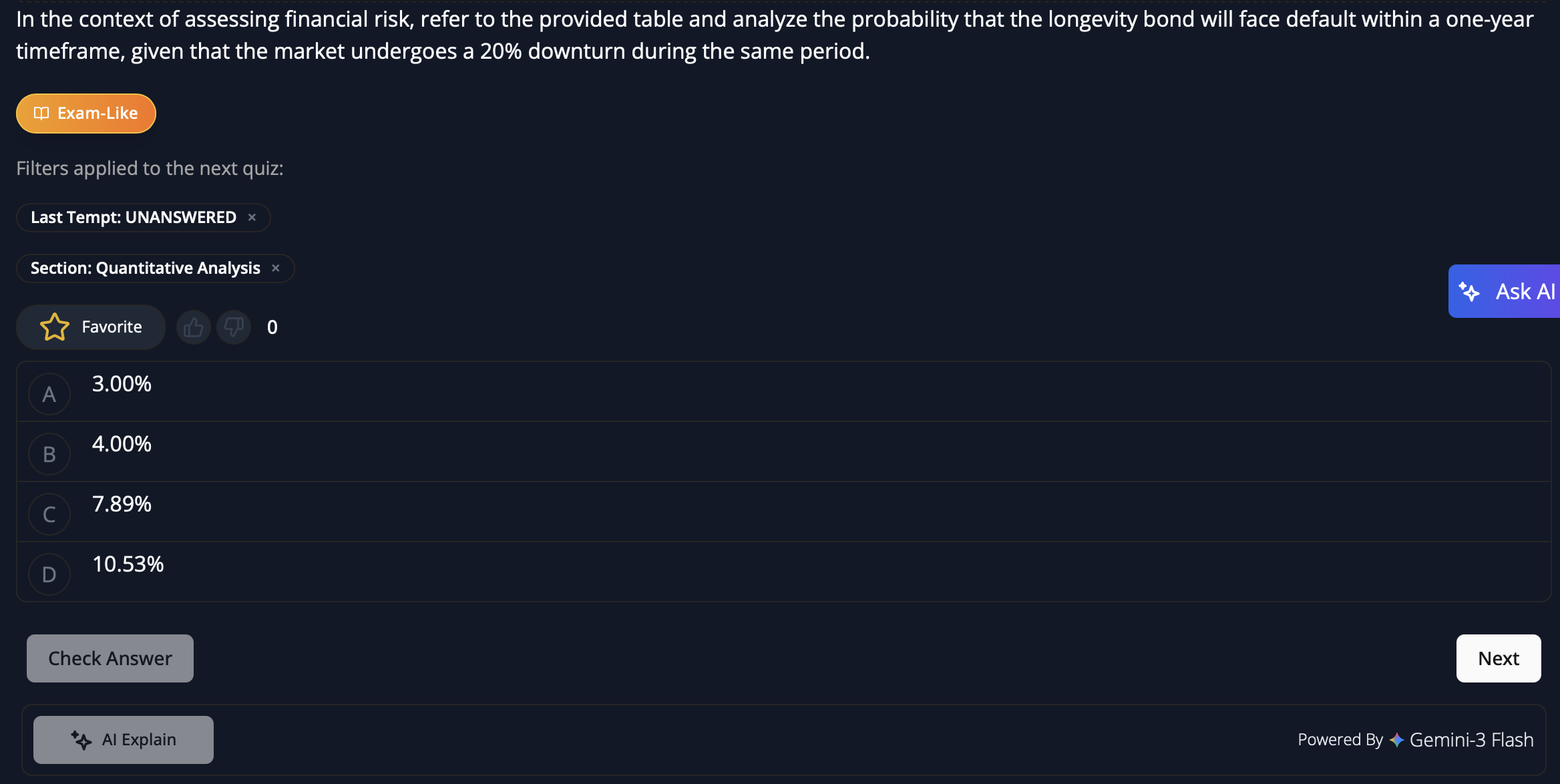
Given the information in the table, what is the probability that the longevity bond defaults in 1 year given that the market decreases by 20% over 1
A
3.00%
B
4.00%
C
7.89%
D
10.53%