Explanation:
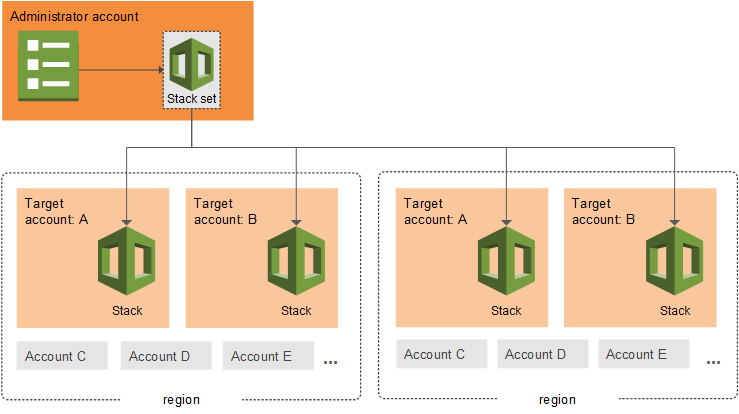
Use AWS Organizations and AWS CloudFormation StackSets. Deploy a CloudFormation template from an account that has the necessary IAM permissions.
The requirement is to define infrastructure as code and support deployments across multiple AWS Regions and multiple AWS accounts as the business expands.
AWS Organizations provides centralized governance and account management, which is essential in a multi-account environment. AWS CloudFormation StackSets extend CloudFormation capabilities by enabling centralized deployment and management of stacks across multiple accounts and Regions from a designated administrator account. This approach ensures consistency, scalability, and operational efficiency while minimizing manual intervention.
For enterprise-scale, multi-account, multi-Region infrastructure as code, CloudFormation StackSets with AWS Organizations is the recommended AWS best practice.
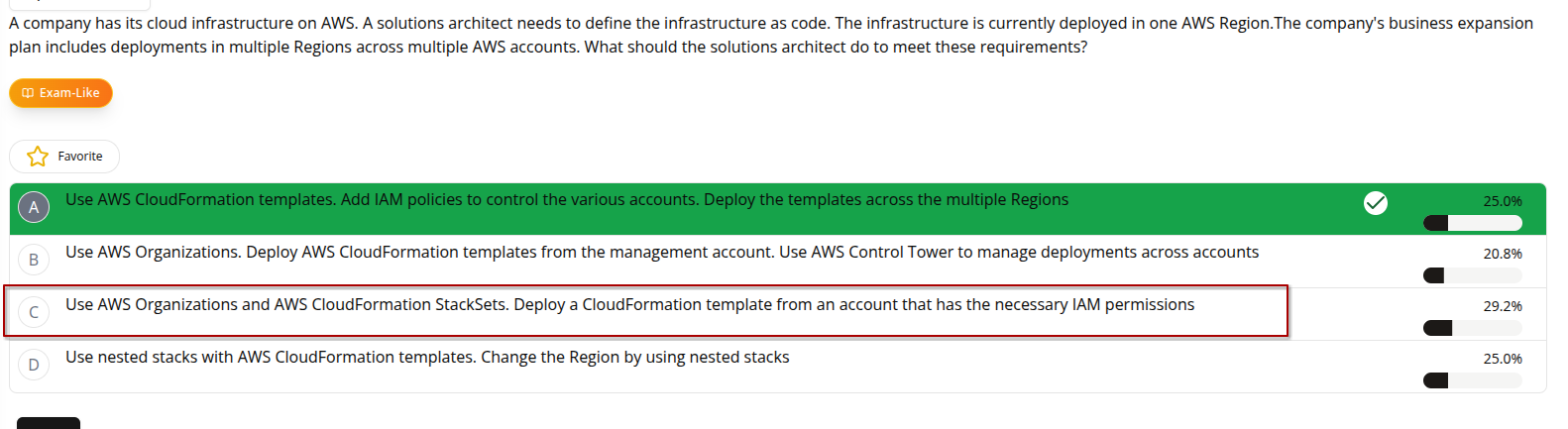
A company has its cloud infrastructure on AWS. A solutions architect needs to define the infrastructure as code. The infrastructure is currently deployed in one AWS Region.The company's business expansion plan includes deployments in multiple Regions across multiple AWS accounts. What should the solutions architect do to meet these requirements?
A
Use AWS CloudFormation templates. Add IAM policies to control the various accounts. Deploy the templates across the multiple Regions
B
Use AWS Organizations. Deploy AWS CloudFormation templates from the management account. Use AWS Control Tower to manage deployments across accounts
C
Use AWS Organizations and AWS CloudFormation StackSets. Deploy a CloudFormation template from an account that has the necessary IAM permissions
D
Use nested stacks with AWS CloudFormation templates. Change the Region by using nested stacks