
Explanation:
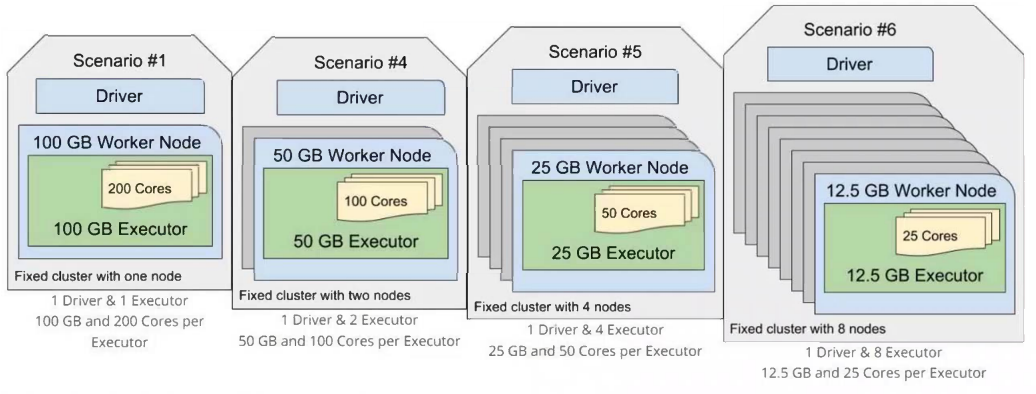
The question asks which cluster configuration is least likely to experience garbage collection delays when processing a large DataFrame, given equal total compute power (100GB RAM, 200 cores). Scenario #6 uses 50 worker nodes with 2GB RAM and 4 cores each, which minimizes the memory per executor. Smaller executor memory reduces the size of objects that need garbage collection, making GC pauses shorter and less frequent. In contrast, larger clusters with bigger executors (like Scenario #1 with 1 worker node of 100GB RAM) keep large DataFrame objects in memory longer, increasing GC delay risks. The community discussion strongly supports E (Scenario #6) with 100% consensus and upvoted comments emphasizing that large clusters retain large DF objects, prolonging GC times.
Which of the following cluster configurations is least likely to experience garbage collection delays when processing a large DataFrame?
Note: Each configuration provides roughly the same total compute power, with 100GB of RAM and 200 cores.
A
Scenario #4
B
Scenario #1
C
Scenario #5
D
More information is needed to determine an answer.
E
Scenario #6
No comments yet.