
Explanation:
The solution meets the goal because: 1) The Azure ML SDK can be installed on the local Surface Book with Python 3.6, enabling connection to the Azure ML workspace; 2) Running the training script as an experiment on local compute is supported by Azure ML, allowing execution of DNN training on the local GPU; 3) Logging loss and accuracy metrics is achievable through Azure ML's logging capabilities (e.g., using Run.log() in the script), which works with local compute; 4) The AKS inference compute target is irrelevant here as the goal is training, not inference. Community consensus strongly supports 'Yes' (78% votes), with highly upvoted comments (e.g., 24 upvotes) confirming local DNN training is feasible. Objections about RAM or CUDA are speculative and not supported by the scenario details, which specify a GPU and necessary software.
No comments yet.
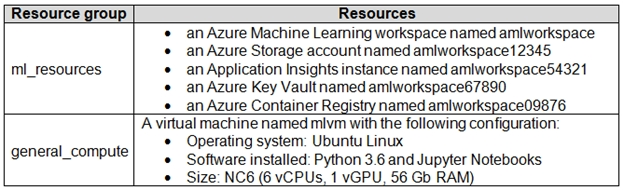
An IT department creates the following Azure resource groups and resources: //IMG//
The department creates an Azure Kubernetes Service (AKS) inference compute target named aks-cluster in an Azure Machine Learning workspace.
You are using a Microsoft Surface Book with a GPU, which has Python 3.6 and Visual Studio Code installed.
Your goal is to run a script that trains a deep neural network (DNN) model and logs the loss and accuracy metrics.
Proposed Solution: Install the Azure ML SDK on the Surface Book. Use Python code to connect to the workspace and run the training script as an experiment on the local compute.
Does the solution meet the goal?
A
Yes
B
No