
Explanation:
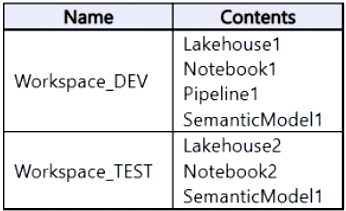
The correct answer is A because deployment pipelines in Microsoft Fabric automatically pair items with matching names between source and target workspaces. Workspace_DEV contains Lakehouse1, Notebook1, Pipeline1, and SemanticModel1, while Workspace_TEST contains Lakehouse2, Notebook2, and SemanticModel1. Since SemanticModel1 exists in both workspaces, it will be paired and updated. Lakehouse1 and Notebook1 from DEV will be deployed to TEST, while Lakehouse2 and Notebook2 in TEST will remain unchanged as they don't have matching names in DEV. The community discussion confirms this approach, with the highest upvoted comment explaining that the solution combines elements from DEV with existing elements in TEST that don't have matches in DEV.
You have a Fabric tenant with the following workspaces:
//IMG//
A deployment pipeline named Pipeline1 is configured to deploy items from Workspace_DEV to Workspace_TEST. In Pipeline1, items with matching names are automatically paired.
After deploying the contents of Workspace_DEV to Workspace_TEST using Pipeline1, what will be the final contents of Workspace_TEST?
A
Lakehouse1 -
Lakehouse2 -
Notebook1 -
Notebook2 -
Pipeline1 - SemanticModel1
B
Lakehouse1 -
Notebook1 -
Pipeline1 - SemanticModel1
C
Lakehouse2 -
Notebook2 - SemanticModel1
D
Lakehouse2 -
Notebook2 -
Pipeline1 - SemanticModel1
No comments yet.