
Explanation:
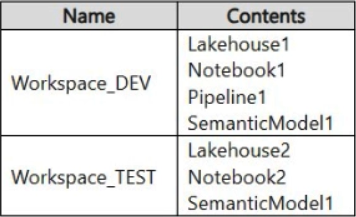
The correct answer is C because in Microsoft Fabric deployment pipelines, when items have matching names between source and target workspaces, they are paired and the source item overwrites the target item. Workspace_DEV contains Lakehouse1, Lakehouse2, Notebook1, Notebook2, Pipeline1, and SemanticModel1. Workspace_TEST initially contains Lakehouse1, Notebook1, Pipeline1, and SemanticModel1. Since all items with matching names are paired, Lakehouse1, Notebook1, Pipeline1, and SemanticModel1 from DEV will overwrite their counterparts in TEST. Additionally, Lakehouse2 and Notebook2 from DEV (which don't exist in TEST) will be deployed to TEST. The community discussion shows 100% consensus on answer C, confirming this deployment behavior where paired items are overwritten and unpaired items are added.
You have a Fabric tenant with the following workspaces:
//IMG//
A deployment pipeline named Pipeline1 is configured to deploy items from Workspace_DEV to Workspace_TEST. In Pipeline1, all items with matching names are paired.
You perform a deployment from Workspace_DEV to Workspace_TEST using Pipeline1.
What will be the final contents of Workspace_TEST after the deployment is complete?
A
Lakehouse2 -
Notebook2 -
SemanticModel1 -
B
Lakehouse1 -
Notebook1 -
Pipeline1 -
SemanticModel1 -
C
Lakehouse1 -
Lakehouse2 -
Notebook1 -
Notebook2 -
Pipeline1 -
SemanticModel1 -
D
Lakehouse2 -
Notebook2 -
Pipeline1 - SemanticModel1
No comments yet.