
Explanation:
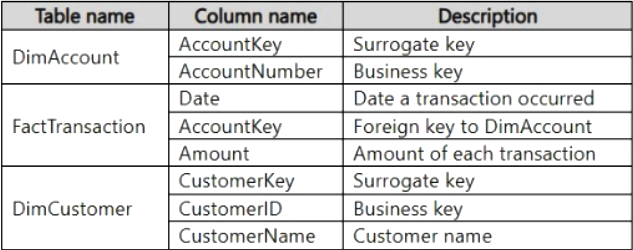
The scenario describes a many-to-many relationship between customers and accounts, where a customer can have multiple accounts and an account can be associated with multiple customers. To enable users to query total transaction amounts by customer, we need to resolve this many-to-many relationship. Option C (a bridge table with relationships to FactTransaction and DimCustomer) correctly addresses this by creating a bridge table that connects transactions to customers through the account relationship. This allows proper aggregation of transaction amounts by customer. Option A is incorrect because it suggests a direct many-to-many relationship which isn't the optimal solution. Option B is incomplete as it doesn't connect to the transaction data. Option D is insufficient because it doesn't handle the many-to-many relationship between customers and accounts. The community discussion shows 100% consensus on option C, confirming it as the correct approach.
You have a semantic model named Model1 containing customer and bank account data. A customer can have multiple accounts, and an account can be associated with multiple customers. You need to enable users to query Model1 to find the total transaction amounts by customer.
What should you add to Model1?
A
a many-to-many relationship between FactTransaction and Dim Customer
B
a bridge table with relationships to DimCustomer and DimAccount
C
a bridge table with relationships to FactTransaction and DimCustomer
D
the CustomerKey column in FactTransaction and a relationship to DimCustomer
No comments yet.