
Explanation:
To meet the specified requirements, we need to add a column that establishes a relationship between employees and their managers while enabling efficient attribute lookups.
Option A: [ManagerEmployeeID] [smallint] NULL
Option B: [ManagerEmployeeKey] [smallint] NULL
Option C: [ManagerEmployeeKey] [int] NULL
Option D: [ManagerName] [varchar](200) NULL
Option C is the optimal choice because:
Surrogate Key Usage: Using ManagerEmployeeKey references the surrogate key rather than business key, providing stability and consistency in relationships.
Data Type Consistency: The int data type matches typical primary key implementations and supports large-scale employee databases without range limitations.
Hierarchy Support: This self-referencing foreign key enables recursive queries to build complete organizational hierarchies using Common Table Expressions (CTEs).
Performance Optimization: Foreign key relationships enable efficient joins to retrieve manager attributes like name and job title from the same table.
NULL Handling: The NULL constraint properly handles employees without managers (e.g., CEO, top executives).
Best Practices Alignment: This approach follows dimensional modeling best practices for data warehousing in Azure Synapse Analytics dedicated SQL pools.
This design allows users to identify managers, traverse reporting hierarchies, and efficiently access manager attributes through simple JOIN operations while maintaining data integrity and scalability.
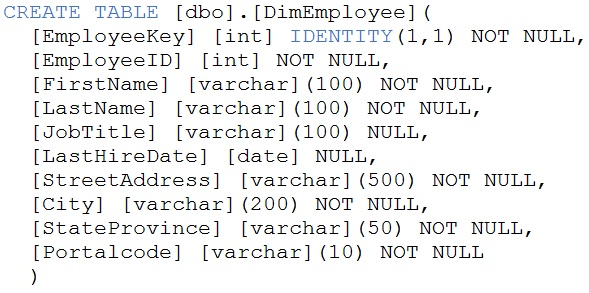
You have a table in an Azure Synapse Analytics dedicated SQL pool that was created using the following Transact-SQL statement:
You need to alter the table to meet these requirements:
Which column should you add to the table?
A
[ManagerEmployeeID] [smallint] NULL
B
[ManagerEmployeeKey] [smallint] NULL
C
[ManagerEmployeeKey] [int] NULL
D
[ManagerName] varchar [blocked] NULL
No comments yet.