Answer-first summary for fast verification
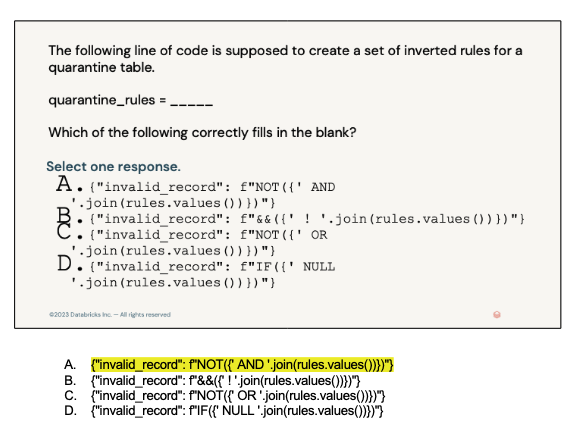
Answer: {"invalid_record": f"NOT({' AND '.join(rules.values())})}"
- Typical setup: each entry in rules.values() is a boolean “pass” check, and a record is valid only when all checks pass (rule1 AND rule2 AND ...). - To mark invalid records you need the negation of that whole conjunction: NOT(rule1 AND rule2 AND ...). Option A produces exactly that, so it flags records where any single check fails. By De Morgan, NOT(A AND B) = (NOT A) OR (NOT B), which matches the goal “any rule failed => invalid.” - Why the others are wrong: - C (NOT(OR(...))) would only flag records when none of the checks are true (too strict). - B uses HTML-encoded/operators (&, !) not appropriate SQL/spark syntax. - D (IF(... NULL ...)) is not a logical negation and doesn’t express the intended condition. Tip: always confirm whether rules are combined with AND (use A) or OR (would need a different inversion).
Author: LeetQuiz .
Ultimate access to all questions.

The following line of code is supposed to create a set of inverted rules for a quarantine table. quarantine_rules = _____
Which of the following correctly fills in the blank?
A
{"invalid_record": f"NOT({' AND '.join(rules.values())})}"
B
{"invalid_record": f"&({' ! '.join(rules.values())})}"
C
{"invalid_record": f"NOT({' OR '.join(rules.values())})}"
D
{"invalid_record": f"IF({' NULL '.join(rules.values())})}"