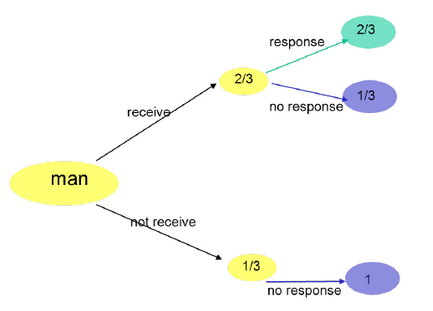
Explanation:
This is a conditional probability problem. Let's define the events:
We want P(R | N)
Given probabilities:
Conditional probabilities:
Using Bayes' Theorem:
P(R | N) = [P(N | R) × P(R)] / P(N)
Where:
Therefore: P(R | N) = [(1/3) × (2/3)] / (5/9) = (2/9) / (5/9) = 2/5
So the probability that his wife received his letter given that he received no response is 2/5.
In country X, the probability that a letter sent through the postal system reaches its destination is 2/3. Assume that each postal delivery is independent of every other postal delivery, and assume that if a wife receives a letter from her husband, she will certainly mail a response to her husband.
Suppose a man in country X mails a letter to his wife (also in country X) through the postal system. If the man does not receive a response letter from his wife, what is the probability that his wife received his letter?
A
1/3
B
3/5
C
2/3
D
2/5