
Answer-first summary for fast verification
Answer: AR(2)
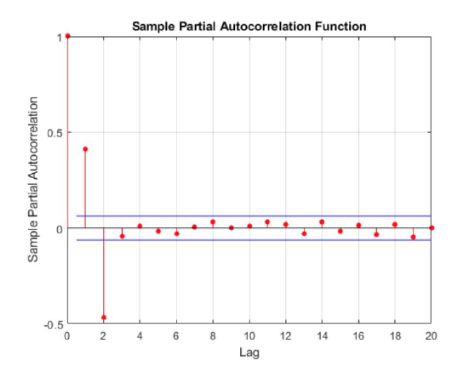
## Explanation The correct answer is **AR(2)** because: - **Partial Autocorrelation Function (PACF)** measures the correlation between observations at different lags while controlling for the effects of intermediate lags - In **AR (Autoregressive) processes**, the PACF cuts off after the order of the AR process - When the PACF plot shows significant spikes at lag 1 and lag 2, but cuts off (becomes insignificant) after lag 2, this indicates an **AR(2) process** - An AR(2) model would be: \(Y_t = \phi_1 Y_{t-1} + \phi_2 Y_{t-2} + \epsilon_t\) - This behavior contrasts with MA (Moving Average) processes, where the ACF (Autocorrelation Function) cuts off after the order of the MA process Therefore, the PACF cutting off after the second lag clearly suggests that an AR(2) model is the most appropriate regression approach for this security's time series data.
Author: LeetQuiz .
Ultimate access to all questions.
A market risk manager would like to analyze and forecast a security performance and has obtained the historical time series for that security. The manager consults a colleague from the quantitative analytic team who provides the following Partial Autocorrelation Function (PACF) plot. Based on the plot above, which of the following is the best regression approach for the security?
A
AR(1)
B
MA(1)
C
AR(2)
D
MA(2)
No comments yet.